

Gynecomastia Surgery

Gynecomastia Surgery

Gynecomastia

If the fullness of your chest makes you feel embarrassed, self-conscious, or reluctant to take off your shirt, you are not alone.
Gynecomastia can make fitted clothing, beaches, pools, locker rooms, intimacy, and even your own reflection feel uncomfortable. You may have trained harder, changed your weight, or hidden your chest without changing the breast-like contour that bothers you.

Gynecomastia surgery, also called male breast reduction, removes enlarged male breast tissue to create a flatter, more proportionate chest contour. Your chest may contain enlarged gland, excess fat, loose skin, or a combination. Your examination determines whether your treatment should include complete gland removal, liposuction, skin management, or a combined approach.

When gland and excess fat coexist, Dr. Mesa plans both components together. Removing the gland without smoothing the surrounding fat can leave a hollow or deep-dish contour. His combined approach is designed to create a smoother transition across your chest.

For qualifying patients, Dr. John Mesa, MD, performs gynecomastia surgery painlessly under local anesthesia. You remain awake without IV sedation or general anesthesia. This approach may also allow an individually cleared patient to protect his privacy by coming to and leaving the procedure without a companion. You may not drive unless Dr. Mesa specifically clears you to do so, and all transportation plans must follow your written instructions.

Painless describes the procedure after the treatment area is anesthetized. It does not mean risk-free or promise a painless recovery. Soreness, swelling, bruising, and tightness vary from person to person.

Speak with a Patient Concierge to ask initial questions, understand the process, and learn the appropriate next step. The call is not a medical consultation. Diagnosis, candidacy assessment, and treatment planning belong to an evaluation with Dr. Mesa.

Gynecomastia Can Involve Gland, Fat, Skin, or a Combination

Many men ask the same first question: what is actually making my chest look this way? The answer matters because different tissues are treated differently.

Glandular gynecomastia. Glandular tissue has enlarged. This is true gynecomastia.

Fat-predominant fullness. The fullness comes mainly from fat, not from enlarged gland. This is often called pseudogynecomastia.

Mixed concerns. Gland, fat, and sometimes stretched or loose skin are all present. This is common, and it is why a single label from a photograph or a mirror is rarely enough.

Appearance alone may not reveal which tissues are involved. Clarifying that is the first step in planning, and it can change which treatment categories are discussed.

What Is Gynecomastia?

Gynecomastia is enlargement of male breast tissue. Male breast reduction is the common name for surgery that reduces that enlargement. The terms gynecomastia surgery and male breast reduction are often used for the same type of care, although the exact operation planned for each man differs.

Chest fullness in men has more than one cause and more than one form. The three descriptions below are general categories for understanding. They are not a way to diagnose yourself.

True Gynecomastia

True gynecomastia involves enlargement of glandular breast tissue. It can affect one side or both. When the two sides differ, that difference is part of what is evaluated.

What Is Pseudo-gynecomastia?

Pseudogynecomastia is male chest fullness caused mainly by excess fat rather than enlarged glandular breast tissue.

Weight-related fat can contribute, but you cannot reliably determine tissue type by looking in a mirror or sending a photograph. Your examination helps distinguish pseudogynecomastia from true gynecomastia and from a mixed condition.

Mixed Gynecomastia

Many men have both glandular tissue and excess fat, and some also have skin that has stretched. A mixed presentation can affect the chest unevenly, which is one reason treatment planning is individualized.

Fullness on only one side, or a change that is new or progressing, may call for medical evaluation before cosmetic planning. That is covered in the next section.

Dr. Mesa Image 1

Why Medical Evaluation May Matter Before Surgery

If chest fullness is affecting how you look or feel, it is reasonable to explore treatment. The possible contributors still deserve attention, because cosmetic planning should not come before an evaluation that is medically appropriate.

Possible Contributors to Male Breast Enlargement

Several categories of factors can contribute:

  • hormonal changes
  • certain medications
  • supplements
  • anabolic steroids or other substances
  • weight-related fat
  • some medical conditions
 

In some men, no identifiable cause is found. Tell your clinician about every medication, supplement, and substance you use, since any of them can matter. Appearance alone does not show which contributor, if any, is involved.

Findings That May Need Medical Evaluation

The following may need medical evaluation before cosmetic treatment is planned:

  • fullness or a lump that is new
  • changes that are significant, rapid, or ongoing
  • a new, distinct, changing, or otherwise concerning firm area or lump
  • pain or tenderness
  • changes on one side only
  • findings that are unexplained or otherwise worry you
 

This page cannot tell you whether any finding applies to you, and it does not replace care from a physician. If you have any of these, raise them with a clinician. During a visit with Dr. Mesa, your history and examination help determine whether medical evaluation should come first.

Painless Gynecomastia Surgery While Awake Under Local Anesthesia

You may be putting off treatment because you fear a painful operation, or because you do not want to be put under.

For qualifying patients, Dr. Mesa performs gynecomastia surgery painlessly under local anesthesia. You remain awake, without IV sedation or general anesthesia.

The word painless here describes the procedure after the treatment area has been anesthetized. It does not describe the recovery. Soreness, swelling, tightness, and other recovery experiences vary and are not universally painless. Painless also does not mean risk-free, and the procedure carries the risks described later on this page.

Gynecomastia Surgery Without IV Sedation or General Anesthesia

No IV Sedation or General Anesthesia

In this pathway, you are not sedated through an IV and you do not receive general anesthesia. 

You stay awake while the treatment area is numb. This is how Dr. Mesa performs the procedure for qualifying patients and treatment plans. It is not a claim that local anesthesia is safer than other anesthesia options, and whether it suits you is part of your evaluation.

Gynecomastia Consultation for Privacy, Companion, and Transportation Planning

Privacy, Companion, and Transportation Planning

Avoiding IV sedation and general anesthesia can matter if you want to keep your procedure private. When Dr. Mesa clears you individually, you may be able to arrive and leave without a companion. This is not automatic, and it never means you may drive yourself without approval.

Depending on your operation, health, medications, and Dr. Mesa’s instructions, a rideshare, public transportation, or air travel may be possible. Confirm the exact plan before surgery. If your treatment or discharge plan requires a responsible adult, you must arrange one.

Gynecomastia Candidacy – Male Chest Tissue Assessment for Surgery

Who May Qualify for Gynecomastia?

Qualification depends on the individual patient and the individual treatment plan.

Dr. Mesa determines this during evaluation, based on your anatomy, the tissues being treated, the extent of treatment, and your health. Not every patient or every plan will qualify.

Dr. Mesa Image 1

How Dr. Mesa Plans Gynecomastia Treatment

When you ask whether you need gland removal, liposuction, or both, the answer begins with your own anatomy.
Planning looks at the tissues present, the quality of the skin, the shape and symmetry of the chest, your health and history, and what you want your chest to look like. A photograph or a description alone is not enough to prescribe a procedure.

Glandular Tissue

Glandular tissue behaves differently from fat. In Dr. Mesa’s surgical technique, when your examination confirms that gland excision is indicated, he removes the entire glandular component rather than intentionally leaving gland behind. Your examination determines whether gland removal is needed and how the surrounding chest must be contoured. It does not determine how much of an indicated gland to leave.

Excess Chest Fat

Fat in the chest is treated differently from gland. Its amount and distribution help determine whether liposuction is part of the plan, either alone or alongside other treatment.

Skin Quality and Laxity

Skin response varies from man to man. Age, skin quality, how much the skin has stretched, the extent of treatment, and individual anatomy can all affect planning. Skin that has stretched may or may not contract after treatment, and this is discussed in advance.

Asymmetry and Chest Anatomy

Many chests are not perfectly symmetrical, and one side can hold more tissue than the other. Planning also considers the position of the nipple-areola complex, the shape of the chest wall, prior procedures or scars, and your overall health and goals. A reasonable goal is a contour that fits your body, not a template.

Gynecomastia Treatment Pathways

You may be wondering whether you need gland removal, liposuction, skin management, or a combination. These are the four treatment categories that may be discussed. Which of them, if any, applies to you depends on evaluation.

Glandular Excision

When gland excision is indicated, Dr. Mesa removes the gland through an incision placed at the border where the areola meets the surrounding skin. He uses this color and texture transition to help the healed scar blend with the areolar edge. Scar visibility and healing still vary, and no scar can be promised to become invisible.

In Dr. Mesa’s technique, the entire glandular component is removed. The surrounding contour must then be planned so the treated area does not look hollow or sharply separated from the rest of your chest.

Chest Liposuction

Liposuction removes excess fat from your chest. Dr. Mesa can introduce the cannula through a small incision at the junction of the areola and normal skin. To reach and blend the full treatment area, an additional small access incision may sometimes be needed near the armpit or breast fold.

Liposuction does not remove the gland itself. Whether liposuction alone is appropriate depends on whether your fullness is primarily fat or includes glandular tissue.

Combined Excision and Liposuction: Preventing a Deep-Dish Deformity

Your gland sits directly beneath the areola and occupies volume in the center of your chest. If you also have surrounding chest fat, removing the gland without blending that fat can leave a hollow that resembles a moon crater. Dr. Mesa calls this a deep-dish deformity.

When gland and fat coexist, Dr. Mesa removes the gland and performs liposuction around the treated area to smooth the transition across your chest. This combined contouring is intended to prevent an abrupt central depression while reducing surrounding fullness. Your anatomy and skin still affect the final contour, and no result can be guaranteed.

Skin Tightening and Skin Management

Your skin may have stretched and may not contract fully after fat or gland removal. 

In an individualized treatment plan, Dr. Mesa may consider radiofrequency-assisted skin tightening with BodyTite or QuantumRF. 

In selected cases, skin removal may also be considered. Larger skin-removal procedures can require more extensive scars.

Which option, if any, fits you depends on your skin, anatomy, and treatment plan.

Dr. Mesa Image 1

Why Chest Contour Planning Matters

Many men worry about being left with a crater, a deep-dish look, or an obviously operated chest. That worry is reasonable, and it is the reason contour planning gets as much attention as removal.

Removing the gland without contouring coexisting chest fat can leave a central depression or deep-dish appearance. Leaving fat untreated can also preserve unwanted fullness. Dr. Mesa plans gland removal and surrounding liposuction together when both components are present so your chest has a smoother transition rather than an abrupt hollow.

Asymmetry, skin response, and the individual goals you set with Dr. Mesa all affect this plan. Skin may contract in some areas more than others, and the two sides of the chest may not respond identically. Your goals are discussed up front so that the plan reflects what you want, including how flat or how full you want your chest to look.

No contour can be guaranteed. The aim is a plan that is realistic for your anatomy.

Dr. Mesa Image 1

Who May Be Considered for Gynecomastia Surgery?

If you are asking whether surgery is right for you, the starting point is an evaluation rather than a checklist. In general, surgery may be considered for adult men who are bothered by persistent chest fullness and who are healthy enough for the planned treatment.

Factors Considered During Gynecomastia Candidacy Assessment

  • the tissues involved: gland, fat, skin, or a combination
  • skin quality and the likelihood of skin laxity
  • whether the fullness has been stable or changing
  • weight history
  • medications, supplements, and substance use
  • overall health and relevant medical history
  • prior chest procedures or scars
  • asymmetry and chest anatomy
  • your goals and your expectations for the result
  • whether the plan qualifies for treatment under local anesthesia

When a Different Next Step May Be Appropriate

Sometimes a different step makes more sense than surgery right now. Examples include:

  • A finding that needs medical evaluation first
  • A possible contributor, such as a medication or substance, that should be reviewed first
  • Fullness that is mainly weight-related, where a different sequence or approach may be discussed first
  • Health factors that affect the safety of the plan
  • Expectations that the surgery cannot realistically meet
  • Skin concerns that call for a different type of plan

A consultation can end with a recommendation to wait, to pursue evaluation, or to consider a different approach. Candidacy, including candidacy for local anesthesia, is determined by Dr. Mesa and not by the Patient Concierge.

Dr. Mesa Image 1

Consultation and Preparation

You may not be sure whether you are ready for a consultation, or what the first step actually involves. There are two separate steps, and they do different jobs.

Gynecomastia Consultation – Complimentary Call with a Patient Concierge

The Complimentary Call with a Patient Concierge

This is a conversation to ask initial questions, understand the process, and learn the appropriate next step. It is not a medical consultation. 

The Patient Concierge does not diagnose gynecomastia, confirm candidacy, select a procedure, create a treatment plan, or promise a result.

Gynecomastia Consultation with Dr. John Mesa – Male Breast Reduction

The Clinical Consultation with Dr. Mesa

This is the evaluation. It may include a review of your history, medications, supplements, and substance use, an examination of your chest and skin, a discussion of your goals, and an explanation of whether and how treatment might proceed, including risks and recovery.

If surgery is planned, you will receive preparation instructions. Tell your care team about every medication, supplement, and substance you use, since these can matter to both safety and planning.

Dr. Mesa Image 1

What Happens During Awake Gynecomastia Surgery?

If you are picturing the day itself, here is the general sequence. The specifics are confirmed during planning.

Local-Anesthetic Preparation

Arrival and plan confirmation. You arrive, and your treatment plan is reviewed again.

Markings and photography. The treatment areas are marked, and photographs are taken for your record.

Local-anesthetic preparation. The treatment area is prepared with local anesthetic.

Complete numbness before treatment. Treatment begins after the area is completely numb.

The Gynecomastia Procedure While Awake

Procedure while awake. For qualifying patients, the procedure is performed painlessly under local anesthesia while you are awake, without IV sedation or general anesthesia.

Comfort checks. Your comfort is checked during treatment.

Completion and Discharge

Dressing and compression. A dressing and compression are applied after treatment.

Discharge and follow-up instructions. You receive instructions for recovery and follow-up before you leave.

Dr. Mesa Image 1

One Patient's Gynecomastia Surgery Journey

Watch one patient describe his experience from consultation through recovery and the questions he considered along the way.

His treatment, recovery, and results are individual, and a consultation is required to determine what may be appropriate for you.

One patient’s account cannot predict your experience. Anatomy, treatment scope, healing, and results differ.

Discreet and no-pressure; no intimate photographs required.

Recovery and Return to Activity

Most men want to know how long before they can work, drive, and train again. The honest answer is that recovery varies with the individual and the extent of treatment, and this page does not set a fixed timeline.

A painless procedure does not mean a painless recovery. You may experience soreness, swelling, bruising, or tightness afterward, and the amount differs from one patient to another.

Early Recovery

Early swelling and bruising are common after chest contouring, and swelling can hide the shape of the result for a time. 

Compression is generally part of early recovery. Your discharge instructions explain what to expect and when to contact the office.

Work and Daily Activity

If you have desk-based or remote work, you may technically be able to return the next day when Dr. Mesa clears you and you feel able to do so. This is not a promise that every patient will be ready the next day. If your job requires lifting, construction work, repetitive upper-body movement, or other physical activity, you may return only with restrictions set by Dr. Mesa for your operation and healing.

Driving is a separate decision. Do not drive unless Dr. Mesa has cleared you, you are not taking medication that impairs driving, and you can safely control the vehicle.

Exercise and Upper-Body Training

Do not exercise or resume upper-body training, including bench press, for at least four weeks after your procedure. Returning too soon can disrupt healing and contribute to complications such as seroma, which is fluid collecting in the surgical space. Dr. Mesa may extend your restrictions based on your operation and recovery. Follow the timeline he gives you rather than a general fitness schedule.

Scars, Risks, and Limitations

Before choosing surgery, you are right to want a clear picture of the tradeoffs. This section describes them in general terms. It is not exhaustive and does not replace the informed consent discussion with Dr. Mesa.

Dr. Mesa Image 8

Scars and Sensation

For gland excision, Dr. Mesa places the incision at the junction of the areola and surrounding skin and uses a closure technique intended to make the healed scar nearly imperceptible.

Liposuction uses small access incisions positioned at the areolar border and, when needed, near the armpit or breast fold so they remain inconspicuous. Your genetics, skin, healing, and treatment affect the final scar, and no scar can be guaranteed to become invisible.

Nipple or chest sensation can change after treatment. Changes may be temporary or persistent, and no outcome can be guaranteed.

Gynecomastia Revision Surgery – Surgical and Healing Risks

Contour, Asymmetry, and Revision

Contour irregularity can occur. Asymmetry can remain, and residual fullness may persist after treatment. Removing too much tissue can create a depressed contour. Skin may not contract as much as hoped, leaving laxity. Revision may sometimes be considered, but it is not guaranteed to be appropriate or to resolve every concern.

Gynecomastia Risks – Seroma After Male Breast Reduction Surgery

Surgical and Healing Risks

Risks of gynecomastia surgery include:

  • bleeding or hematoma
  • seroma, a collection of fluid
  • infection
  • delayed healing
  • contour irregularity
  • asymmetry
  • residual fullness
  • over-resection or contour depression
  • changes in nipple or chest sensation
  • skin laxity
  • persistent discomfort
  • scarring
  • the possibility of revision
  • dissatisfaction with the result

Other procedure-specific risks may apply, and Dr. Mesa reviews them with you.

Results and Realistic Expectations

You may have a flat, defined chest in mind, and it helps to know what surgery can realistically offer. Results may include a flatter chest, reduced fullness, a more proportionate contour, and a smoother transition into surrounding tissue, shaped by the goals you set with Dr. Mesa.

Results take time to show. Early swelling can affect appearance, and scars mature gradually. Skin contraction varies, and some asymmetry can remain. Results vary from patient to patient.

Long-term appearance can also be influenced by weight, hormones, medications, substances, and aging. Chest fullness may change after treatment, and recurrence cannot be ruled out. Revision may sometimes be considered.

Surgery changes how the chest looks. It does not promise a particular body ideal, and it does not promise changes in how you feel about yourself or in your relationships.

Dr. Mesa Image 1

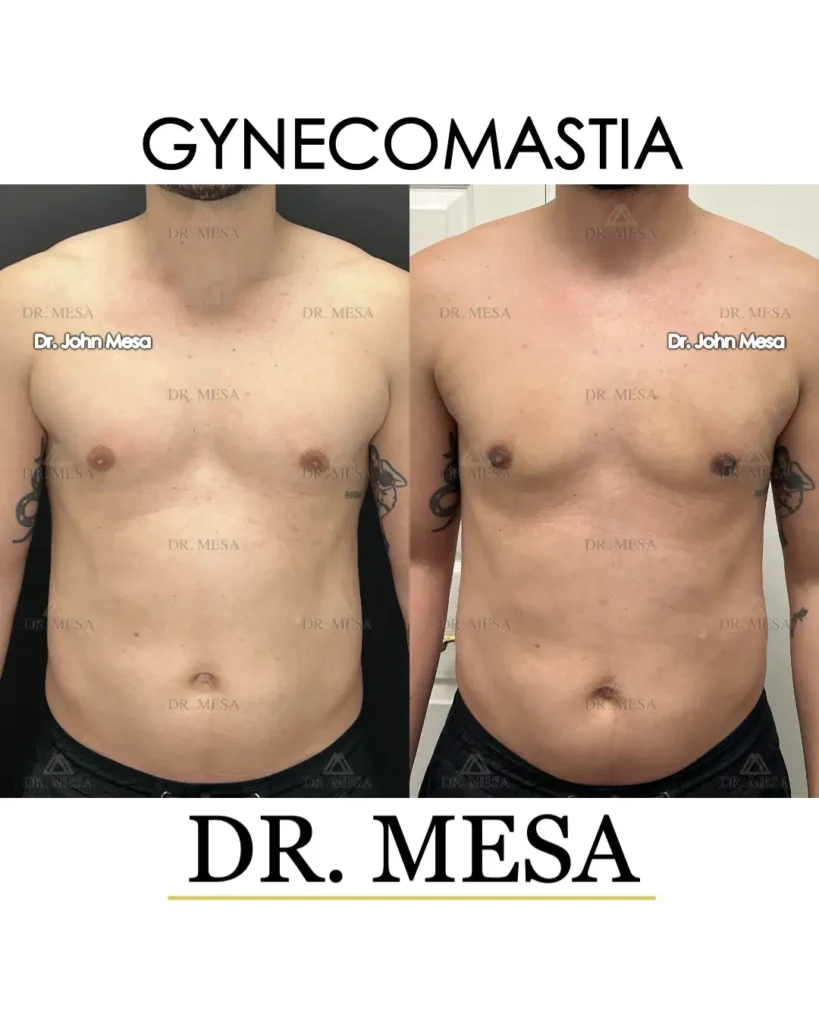
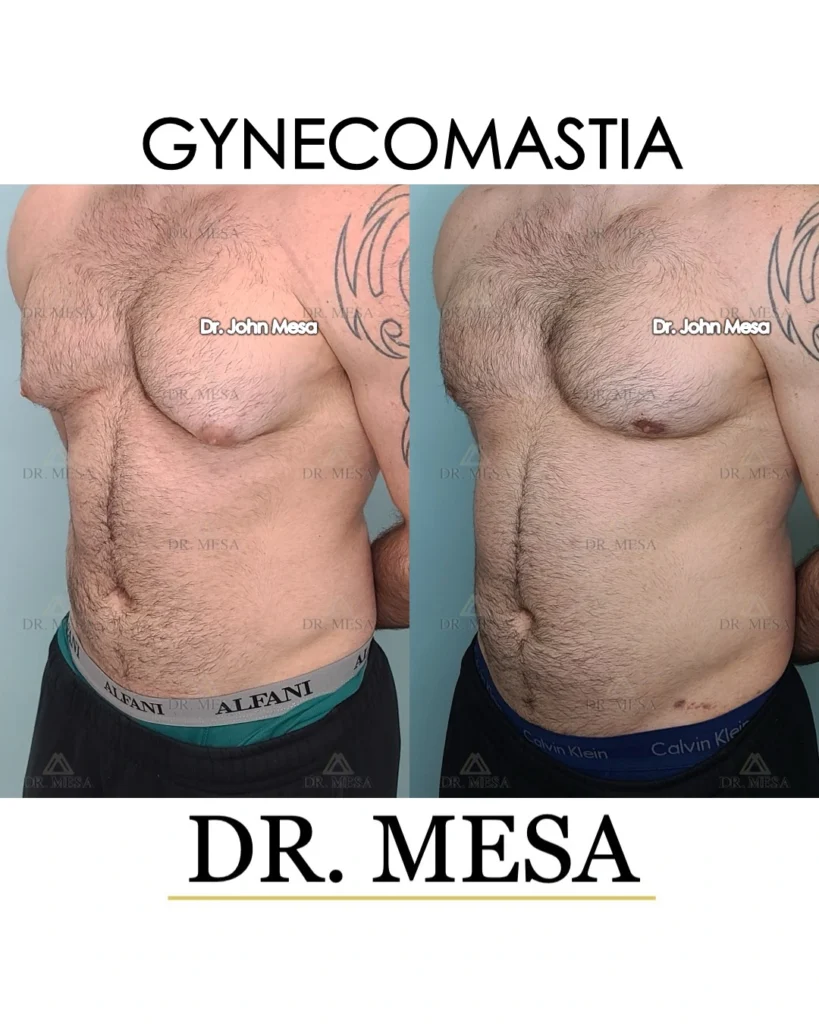
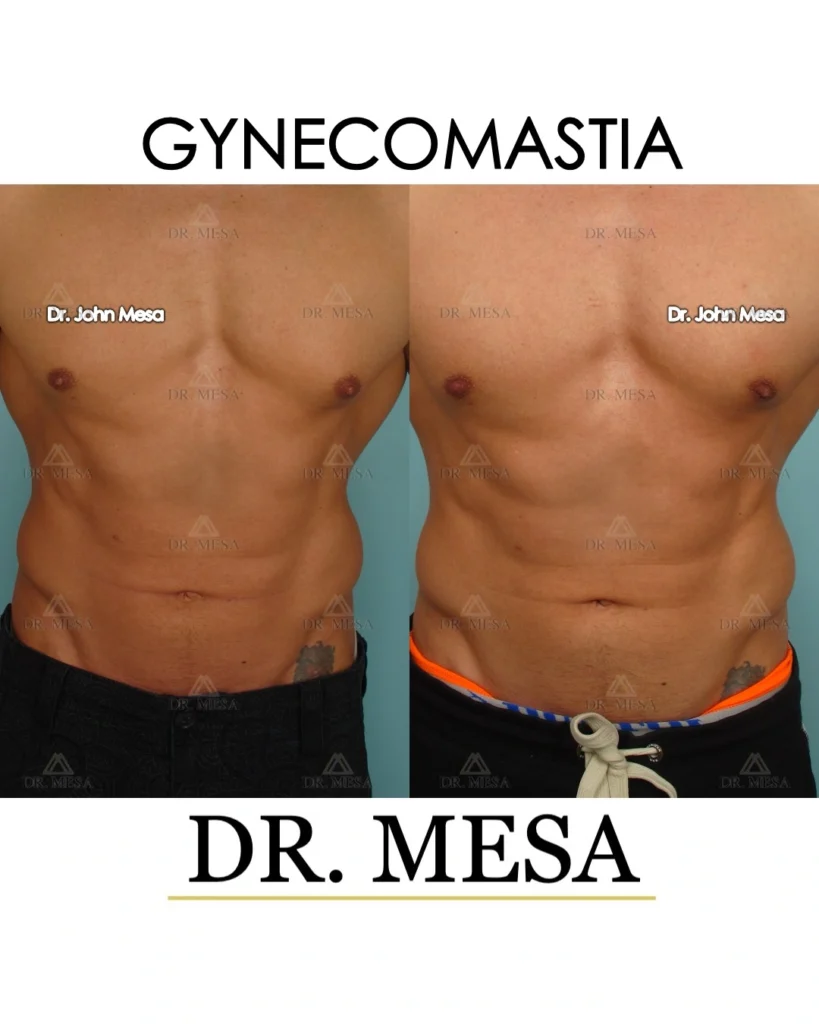
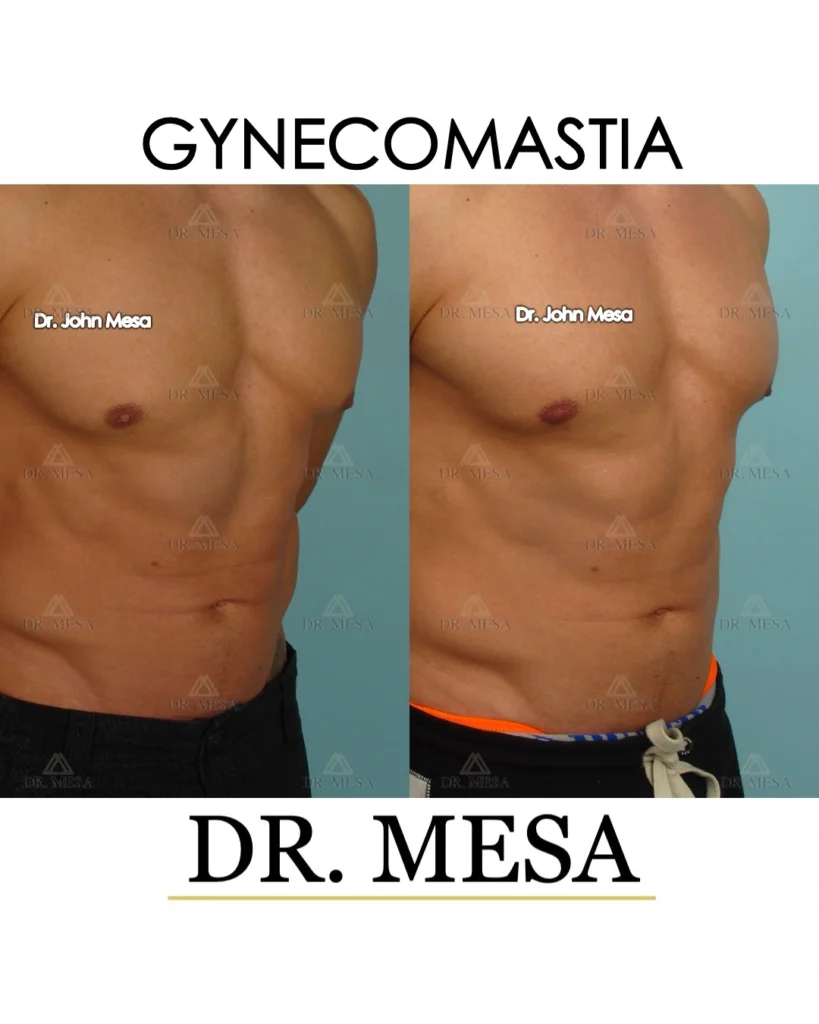
Gynecomastia Before-and-After Results

Photographs can help you judge what is realistic, and they should be viewed with care. Each case on this page will show one patient’s result, not a promise of yours. Look for consistent lighting, angles, and posture, and for a stated interval since treatment.

Individual patient experience; results vary. Ask to see the original before-and-after photographs at your consultation.

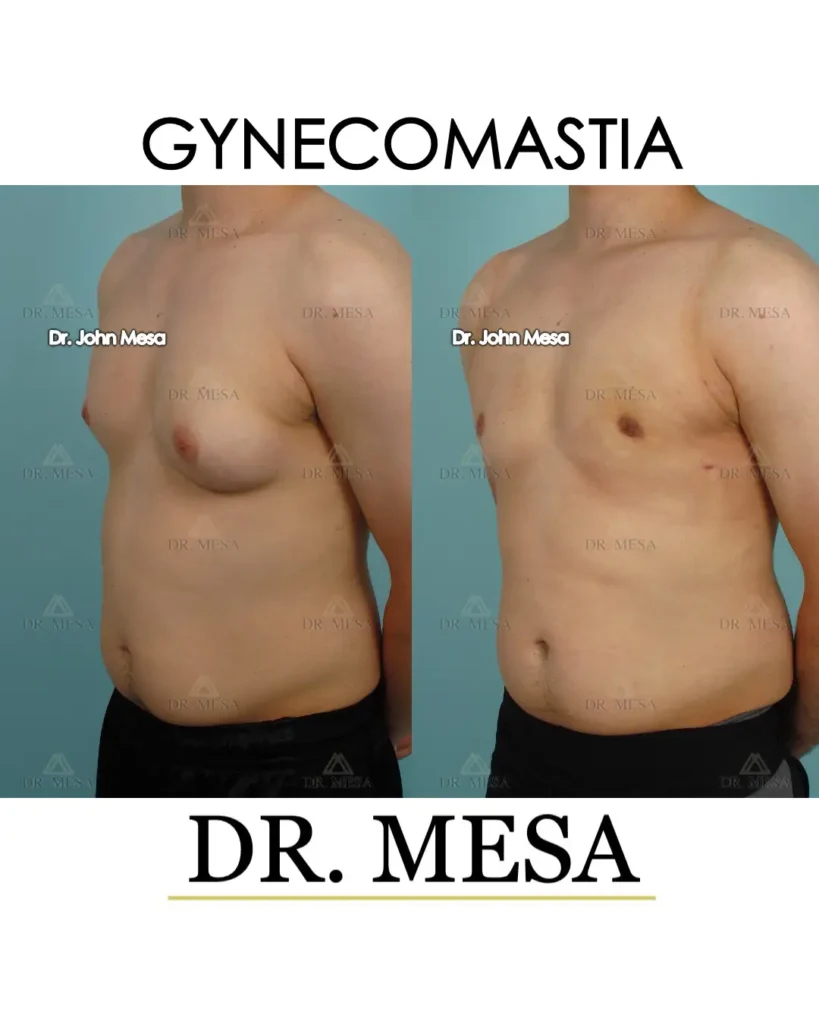
GYNECOMASTIA Before & After Photos

Before and After Gynecomastia on 25 year old male patient
Gynecomastia before and after results on a male patient
Side angle of Gynecomastia before and after photos of a male patient
Gynecomastia before and after results on a male patient in NYC
Before and after Gynecomastia results on a male patient in New Jersey
Dr. John Mesa operates on a male patient for Gynecomastia surgery in Miami.
Gynecomastia surgery on a male patient before and after photos
Patient before and after photos of Gynecomastia in New Jersey
Male patient after Gynecomastia results in New Jersey
Male before and after gynecomastia surgery
Gynecomastia before and after photos NYC
Before and after photos of male patient after Gynecomastia surgery in NYC

A Patient's Gynecomastia Surgery Experience

Men considering this surgery tend to ask the same things: whether it hurts, how visible the scars will be, and when they can train again. Each account below will describe one man's experience, not a prediction of yours.

Gynecomastia Before and After – Male Chest Contouring Results

Gynecomastia Before and After Review

“The procedure was very comfortable. It was non-painful whatsoever. It was fast too, and recovery was very comfortable too. It was good, overall a beautiful experience. It wasn’t as long as I thought it was gonna be.

My confidence has gone up and I feel very, very good. Really good. 

My friends at the gym are asking me about any problems with lifting or anything like that, any strict diets I have to do. I was like, ‘No, not at all. It’s really easy. It’s really comfortable. It’s not painful whatsoever.’

Overall, the gynecomastia results was flawless. Thank you, Dr. Mesa.”

Dr. Mesa Image 1

What Affects the Cost of Gynecomastia Surgery?

Gynecomastia cost depends on the individualized treatment plan. Factors that influence an individualized quote include:

  • the tissues being treated: gland, fat, skin, or a combination
  • which treatment category or categories are planned
  • whether skin management is part of the plan
  • whether the plan is a first procedure or a revision
  • the extent of treatment on each side of the chest
  • what is included in the quote
Dr. Mesa Image 11

Why Consult With Dr. John Mesa, MD?

You want to know who will evaluate your chest, how that person decides what to recommend, and whether he will tell you honestly if surgery is not the right step.

Dr. John Mesa, MD is a plastic surgeon. Treatment planning is individualized, based on the tissues involved, your skin, your anatomy, your health, and your goals.

For qualifying patients, he performs gynecomastia surgery painlessly under local anesthesia while the patient is awake, without IV sedation or general anesthesia. An evaluation may conclude that a different next step, including medical evaluation first, is more appropriate.

Begin with a Complimentary Call

If you are still unsure what is causing your chest fullness, or whether surgery makes sense, a conversation is a reasonable place to start. You do not need to have decided anything.

Speak with a Patient Concierge to ask initial questions, understand the process, and learn the appropriate next step.

The Patient Concierge does not diagnose gynecomastia, confirm candidacy, select a procedure, provide a medical consultation, or create a treatment plan. Those clinical decisions belong to an evaluation by Dr. Mesa. Neither the Patient Concierge nor Dr. Mesa can promise a result.

New York and New Jersey Offices, with Support for Traveling Patients

Dr. Mesa sees patients through offices in New York and New Jersey. If you live in Connecticut, the Philadelphia area, elsewhere in the region, or farther away, the Patient Concierge can explain scheduling and help you understand which logistical questions must be resolved before you travel.

Travel does not change candidacy requirements, and medical clearance, companion needs, transportation, and timing are determined individually.

Dr. John Mesa NYC Plastic Surgeon – New York City Office Location

New York Office

Gynecomastia is available at Dr. Mesa’s Manhattan flagship office in New York City.

Dr. John Mesa's office in New Jersey.

New Jersey Office

Gynecomastia is available at Dr. Mesa’s office in New Jersey.

Dr. Mesa Image 1

Gynecomastia Surgery FAQs

Procedure Details

The two terms are commonly used for the same type of care: surgery to reduce enlarged male breast tissue. The exact treatment planned for each man depends on his tissue composition, skin, anatomy, and goals, and can include gland removal, liposuction, skin management, or a combination.

True gynecomastia is enlargement of the male breast caused by an enlarged breast gland. Pseudogynecomastia is enlargement of the male chest caused by excess fat without enlargement of the breast gland. You can also have both an enlarged gland and excess chest fat, which is why an examination is needed to determine which tissues are involved.

Potential contributors to glandular enlargement include hormonal changes, certain medications, supplements, anabolic steroids or other substances, and some medical conditions. Weight-related fat can contribute to fat-predominant chest fullness. In some men, no identifiable cause is found.

Through evaluation of your history and chest, including the balance of gland, fat, and skin, along with asymmetry, anatomy, health, and your goals. The choice is not made from photographs or symptoms alone. Gland and fat frequently coexist, so a combination is sometimes considered.

Candidacy

No. Exercise and weight changes may affect fat-related fullness. Whether glandular tissue is present, and what treatment may help, requires evaluation.

Fullness or a lump that is new, significant, unexplained, changing, firm, painful, or on one side only may need medical evaluation before cosmetic planning. Any finding that worries you is worth raising with a clinician. This answer is general and is not a diagnosis.

Qualification depends on your anatomy, the treatment plan, and your health, and is determined by Dr. Mesa during evaluation. Not every patient or plan will qualify.

Gynecomastia Surgery

For qualifying patients, Dr. Mesa performs gynecomastia surgery painlessly under local anesthesia. The procedure is painless once the treatment area is anesthetized. Recovery is different, and soreness, swelling, and tightness vary and are not universally painless.

For qualifying patients and treatment plans, yes. You remain awake under local anesthesia, without IV sedation or general anesthesia.

Not for qualifying patients and treatment plans. In this pathway, the procedure is performed with local anesthesia while the patient is awake.

When skin has stretched and may not contract on its own after treatment. Radiofrequency-assisted skin tightening may be considered in an individualized treatment plan, and skin removal may be considered in selected cases. Skin response varies, and no result is guaranteed.

No. For gland excision, Dr. Mesa places the incision at the junction of the areola and normal skin and uses a technique intended to make it nearly imperceptible after healing. Liposuction access incisions are small and positioned to remain inconspicuous. Scar visibility varies, and no scar can be guaranteed to become invisible.

No. Nipple or chest sensation does not change after treatment. Changes may be temporary or persistent, and no outcome can be guaranteed.

Recovery and Results

You may be able to return to desk-based work the next day if Dr. Mesa clears you and you feel ready. Physical work requires restrictions based on your operation and healing. Do not exercise or resume upper-body training, including bench press, for at least four weeks, because returning too soon can disrupt healing and contribute to seroma. Do not drive until Dr. Mesa clears you.

It can. Weight, hormones, medications, substances, and aging can influence long-term appearance, and recurrence cannot be ruled out. Revision may sometimes be considered.

No. Results vary with anatomy, tissue composition, skin response, healing, and long-term factors. Early swelling can affect appearance, scars mature over time, and some asymmetry can remain.

Cost and Consultation

The tissues being treated, the treatment categories planned, whether skin management is included, whether the procedure is a revision, the extent of treatment, and what the quote includes. No prices are published on this page, and cost depends on the individualized treatment plan.

Start by booking a Complimentary Call with a Patient Concierge. The call is for initial questions and understanding the process. It is not a medical consultation, and it does not diagnose, confirm candidacy, or select a procedure. A clinical evaluation with Dr. Mesa is the step that does.